Snohomish County averages 38 inches of rain per year, 140+ overcast days, and winter temperatures that routinely dip into the mid-20s°F. That combination of persistent moisture, limited solar gain, and cold snaps puts more stress on residential windows than any other climate in the continental U.S. When windows fail here, they don’t just leak heat. They allow moisture infiltration, trigger mold growth behind drywall, and drive heating bills well above regional averages. Choosing the right replacement window for a Pacific Northwest home isn’t about picking the prettiest frame. It’s about matching glass, frame, and seal specifications to what this climate actually throws at a building envelope.
Why Pacific Northwest homes lose more heat through windows than you think
Windows account for 25-30% of residential heating and cooling energy loss in a typical U.S. home, according to the U.S. Department of Energy, and in Pacific Northwest homes built before 1990, that figure runs higher. Older construction in Snohomish County frequently used single-pane aluminum-frame windows with no thermal break, and even early double-pane units installed in the 1990s have degraded seals that no longer meet their original performance ratings.
Older homes in Snohomish County face a specific problem
Pre-1990 homes in the Puget Sound region lose an estimated 35% of their heating energy through windows and doors combined, based on DOE building stock analysis. The core issue isn’t just outdated glazing. It’s aluminum frames with no thermal break. Aluminum conducts heat roughly 1,000 times faster than wood or uPVC. That turns the frame itself into a cold bridge, radiating heat out of the room regardless of what the glass unit does. In a climate where indoor-outdoor temperature differentials regularly hit 30-40°F from November through March, that conductivity difference translates directly into higher gas and electric bills every single month.
Homes built between 1990 and 2005 face a different but equally common problem: failed IGU (insulating glass unit) seals. When the seal between panes breaks down, argon or krypton gas fill escapes and is replaced by humid air. The result is visible fogging between panes, along with a U-Factor that has climbed back toward single-pane performance levels while the homeowner assumes the window is still working as installed.
What U-Factor and air infiltration ratings actually mean for a wet climate
Windows rated U-Factor ≤0.28 and air leakage ≤0.30 cfm/ft² are the minimum performance thresholds for ENERGY STAR qualification in Snohomish County, and in a climate defined by wind-driven rain and persistent humidity, the air leakage number matters just as much as the thermal rating. Most homeowners know to ask about U-Factor. Almost none ask about AL.
The AL rating: the spec most homeowners miss
Air leakage below 0.30 cfm/ft² is the NFRC-certified threshold that separates a weather-tight window from one that will admit moisture-laden Pacific Northwest air into your wall cavity. A window with an excellent U-Factor but a poor AL rating will still allow cold, wet exterior air to infiltrate around the frame, negating much of the thermal benefit and introducing the moisture that drives mold growth in PNW wall assemblies. On exposed, wind-facing elevations in coastal or hillside Snohomish County locations, target AL ≤0.20 cfm/ft².
NFRC-certified AL ratings are published on the same label as U-Factor and SHGC. Ask your installer for the NFRC Certified Products Directory listing number, not just a manufacturer specification sheet, before signing a contract.
| ENERGY STAR Zone | U-Factor Max | SHGC Max | AL Max | Example WA Counties |
|---|---|---|---|---|
| Northern | 0.27 | 0.40 | 0.30 cfm/ft² | Ferry, Pend Oreille, Stevens |
| North-Central | 0.28 | 0.40 | 0.30 cfm/ft² | Snohomish, King, Pierce, Whatcom |
| South-Central | 0.30 | 0.25 | 0.30 cfm/ft² | Yakima, Benton, Walla Walla |
| Southern | 0.32 | 0.25 | 0.30 cfm/ft² | N/A for WA state |
Sources: ENERGY STAR Program Requirements for Residential Windows (EPA, 2025); NFRC 400 Air Leakage Standard
Are triple-pane windows worth it in the Pacific Northwest?
Triple-pane windows deliver U-Factors as low as 0.15-0.20 in certified configurations, 25-45% better than the 0.28 maximum a double-pane unit must hit to qualify for ENERGY STAR in the North-Central zone. For Snohomish County homeowners heating with natural gas or electric resistance, that performance gap translates to measurable annual savings.
Double-pane vs triple-pane: the numbers side by side
A triple-pane window with two low-emissivity coatings and krypton gas fill achieves a center-of-glass U-Factor of approximately 0.10. Whole-window U-Factor, including the frame, typically lands at 0.17-0.22, depending on frame material and depth. That’s a meaningful improvement over the best double-pane units, which typically reach whole-window U-Factors of 0.25-0.28 under real-world conditions.
| Specification | Standard Dbl-Pane | Hi-Perf Dbl-Pane | Triple-Pane |
|---|---|---|---|
| Typical U-Factor (whole window) | 0.30-0.35 | 0.25-0.28 | 0.15-0.22 |
| Low-E Coating | Single | Double | Double |
| Gas Fill | Argon | Argon | Krypton or Argon |
| Condensation Resistance (CR) | 30-45 | 45-55 | 55-70 |
| Sound Transmission Class (STC) | 26-28 | 28-32 | 32-36 |
| ENERGY STAR N-Central Qualified | Often not | Yes (if AL ≤0.30) | Yes |
| Cost Premium vs Standard | Baseline | +15-25% | +30-50% |
Sources: NFRC Certified Products Directory (2025); Lawrence Berkeley National Laboratory Window Energy Rating Data
The cost premium for triple-pane is real, typically 30-50% over a standard double-pane unit. In a heating-dominated climate like Snohomish County’s, where homes run furnaces for 6-7 months of the year, the payback window on that premium runs 7-12 years based on DOE regional energy cost data. Some European window manufacturers have standardized on triple glazing across their entire product line rather than offering it as an upgrade. OKNOPLAST’s PAVA system, for instance, ships triple-pane as standard, achieving a whole-window U-Factor of 0.20, which removes the upgrade decision entirely from the buying process.
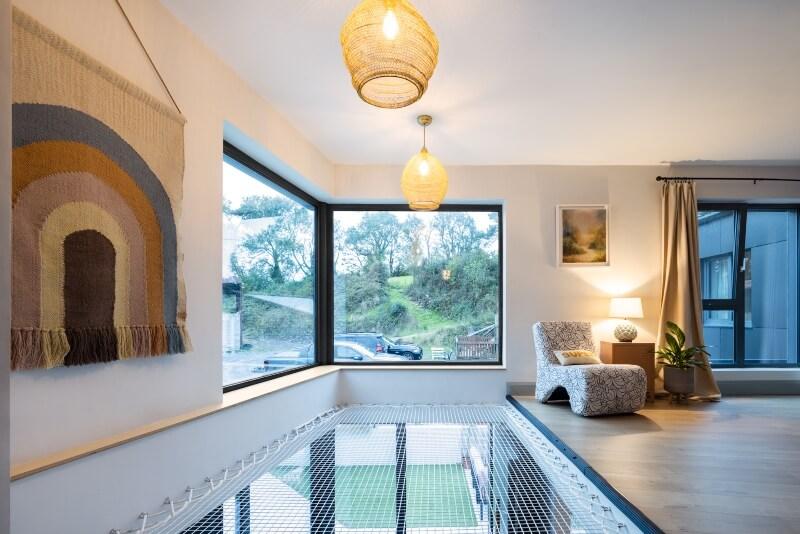 A triple-pane window installation suited to the Pacific Northwest’s heating-dominated climate.
How does tilt & turn technology handle PNW rain and humidity?
Tilt & turn windows seal at 5-7 points around the frame perimeter simultaneously, compared to the 2-point contact of a standard double-hung, which is why they consistently achieve lower air leakage ratings and outperform conventional windows in wind-driven rain conditions. For a region that sees 140+ rainy days per year, that mechanical difference is the most practically relevant spec comparison you can make.
Standard double-hung windows seal at two points: top and bottom sash contact. When wind-driven rain hits at an angle, common in PNW storms, single-point or two-point seals allow water infiltration at corners where pressure is highest. Multi-point compression seals distribute clamping force evenly around the entire frame perimeter, delivering measurably lower AL ratings at equivalent price points.
The tilt function, opening the sash inward from the top, provides ventilation without exposing the interior to direct rain ingress. On the roughly 140 days a year when Snohomish County homeowners want fresh air but can’t open a standard window without rain blowing in, this is a functional advantage that double-hung and horizontal slider designs can’t match.
OKNOPLAST’s tilt & turn systems (e.g. https://oknoplast.us/tilt-and-turn-windows/) – including the PAVA and PIXEL lines available through the U.S. dealer network – use steel-reinforced uPVC profiles with 7-chamber construction, delivering AL ratings well below the 0.30 cfm/ft² NFRC threshold for North-Central ENERGY STAR qualification.
What does window condensation tell you about your home’s thermal envelope?
Interior condensation forms when the glass surface temperature drops below the indoor dew point, a condition triggered when whole-window U-Factor exceeds 0.30 in a home running normal occupant humidity levels. In PNW homes where indoor humidity already runs higher due to outdoor moisture loads, that threshold is reached more easily than in drier climates. Condensation is a diagnostic signal, not a cosmetic problem, and its location tells you exactly what’s failing.
Interior condensation vs exterior condensation: what each means
Interior condensation forms when the glass surface temperature drops below the room’s dew point, typically when whole-window U-Factor exceeds 0.30 at standard PNW indoor humidity of 40-50% RH. A window that performs adequately in Phoenix will condensate in Everett under the same humidity conditions, because the outdoor temperature differential is larger and the glazing surface runs colder for more months of the year.
| Condensation Location | Cause | Diagnosis | Solution |
|---|---|---|---|
| Interior glass surface | U-Factor too high | Glazing upgrade needed | Triple-pane or hi-perf double-pane |
| Between panes (fogging) | Failed IGU seal | Window replacement required | Replace full window unit |
| Frame/corners only | Thermal bridging | Frame material issue | Switch to uPVC or thermally broken aluminum |
| Exterior glass surface | Outer pane cold (high performance) | Good sign | No action needed |
| Wall around window | Air infiltration (AL too high) | Seal or replace | Weatherstripping or full replacement |
Source: Building Science Corporation, “Window Condensation Resistance and the Building Envelope” (2024)
Condensation Resistance (CR) ratings from NFRC run 1-100: higher is better. For PNW homes, target CR ≥50 for double-pane units and CR ≥60 for triple-pane. These ratings directly reflect interior glass surface temperature under standardized cold conditions, the exact scenario Snohomish County homes face from November through February.
 Interior condensation like this is a diagnostic signal of window performance, not just a cosmetic issue.
Which Washington State rebates and tax credits apply to window replacement?
Window replacement in Washington state qualifies for up to $600 per window under the federal §25C Energy Efficient Home Improvement Credit, with a $1,200 annual household cap, plus utility rebates from Puget Sound Energy and Snohomish County PUD that stack on top of the federal credit.
How to stack a federal credit with a PSE or SnoPUD rebate
The §25C federal credit covers 30% of the cost of ENERGY STAR-certified windows, up to $600 per window and $1,200 per year per household. NFRC certification and climate zone compliance (U-Factor ≤0.28, SHGC ≤0.40 for Snohomish County) are the eligibility requirements. The credit applies to both materials and installation costs, and is claimed on IRS Form 5695 with your annual return.
Puget Sound Energy offers rebates of $4-$8 per window for qualifying ENERGY STAR replacements for residential customers. Snohomish County PUD runs a separate window rebate program for its service territory. Verify current amounts directly with SnoPUD before purchasing, as program funding levels change seasonally.
| Program | Amount | Eligibility | How to Claim |
|---|---|---|---|
| Federal §25C Credit | 30% of cost, max $600/window, $1,200/yr | ENERGY STAR certified, NFRC rated, primary residence | IRS Form 5695 |
| Puget Sound Energy Rebate | $4-$8 per window | ENERGY STAR certified, PSE electric customer | Online application post-installation |
| Snohomish County PUD Rebate | Varies (verify with SnoPUD) | ENERGY STAR certified, SnoPUD customer | SnoPUD online portal |
| WA State Sales Tax Exemption | Varies | Energy-efficient products (verify with WA DOR) | Applied at point of sale |
Sources: IRS Publication 5886 (§25C, 2025); Puget Sound Energy Residential Rebates (pugetenergy.com, 2025); SnoPUD Energy Efficiency Programs (snopud.com, 2025)
NFRC certification is the key that unlocks every program in this table. Any window you’re considering should have a published NFRC label with U-Factor, SHGC, VT, and AL ratings, not just a manufacturer claim, since that verification belongs in the same category as other preventive home maintenance homeowners tend to overlook.
How to choose the right window for a Pacific Northwest home: a spec checklist
Five specifications are non-negotiable for any window replacement in Snohomish County: U-Factor ≤0.28, AL ≤0.30 cfm/ft², triple glazing, multi-point compression seal, and NFRC certification. Every other feature is secondary to these five.
| Specification | Minimum for PNW | Preferred for PNW | Why It Matters |
|---|---|---|---|
| U-Factor | ≤0.28 (ENERGY STAR) | ≤0.22 (triple-pane) | Thermal resistance against cold winters |
| Air Leakage (AL) | ≤0.30 cfm/ft² | ≤0.20 cfm/ft² | Moisture and draft infiltration prevention |
| Glazing | Double-pane minimum | Triple-pane preferred | U-Factor, CR, and sound performance |
| Condensation Resistance | CR ≥45 | CR ≥60 | Interior surface temp in PNW winters |
| Frame Material | uPVC or thermally broken aluminum | uPVC multi-chamber | Eliminate thermal bridging |
| Seal Type | Two-point minimum | Multi-point compression | Wind-driven rain resistance |
| NFRC Certification | Required | Required | Tax credit and rebate eligibility |
| Operation Type | Any | Tilt & turn preferred | AL performance + wet-weather ventilation |
Source: NFRC Product Certification Standards; DOE Building Technologies Office Window Guidance (2025)
Lead times are a practical factor worth building into any renovation timeline. European window systems imported to the U.S. – including those from manufacturers like OKNOPLAST, which operates a growing dealer network across Washington, Oregon, and neighboring Northwest states – carry 8-10 week lead times from order to installation. Order windows before you schedule other finish work – that 8-10 week lead time won’t compress just because the rest of the job is ready.
The post Energy Efficient Windows for Pacific Northwest Homes: What the Climate Actually Demands appeared first on Better Living.
from Better Living https://ift.tt/ax1hAvp
0 Comments
Post a Comment